
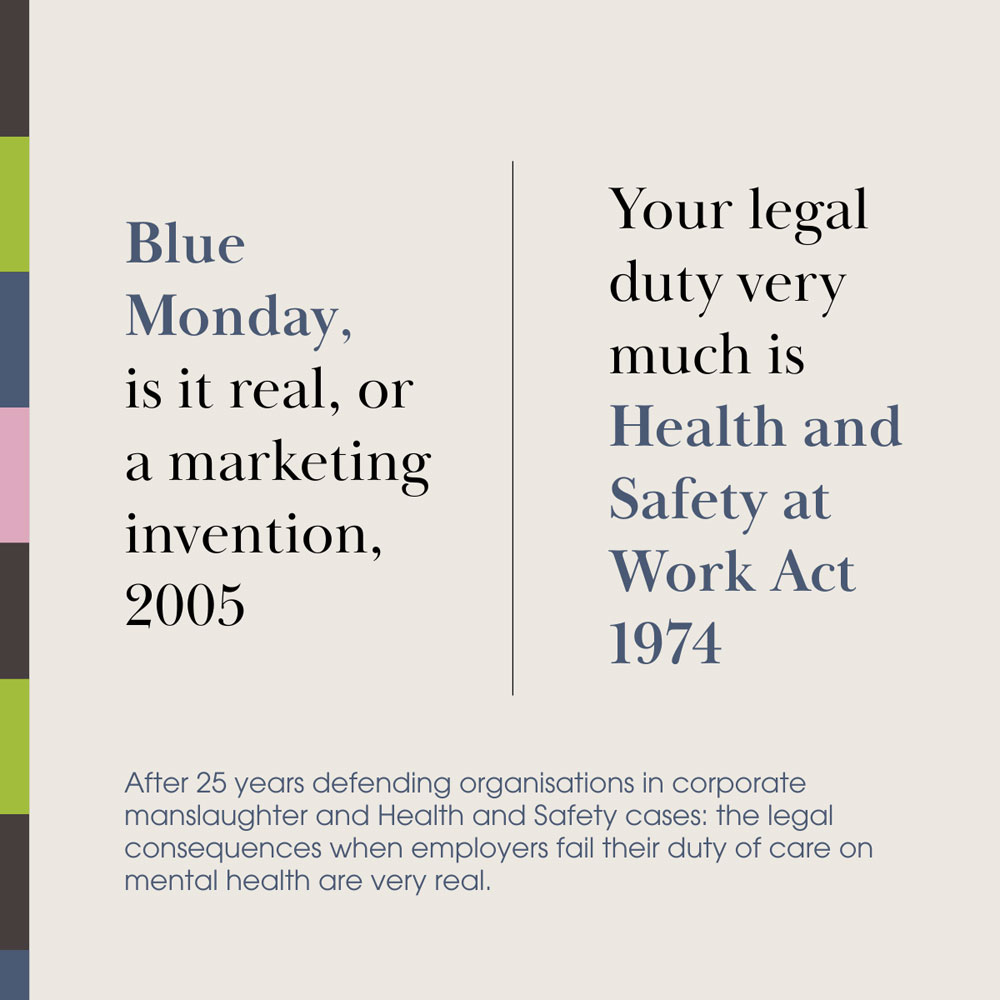
Blue Monday isn’t real. Your legal duty to protect employee mental health is.
So apparently, today is ‘Blue Monday’, the most depressing day of the year. Except it’s not. It’s a marketing myth from 2005 with no scientific basis whatsoever.
But here’s what we know is very real in corporate manslaughter and health and safety cases: the legal consequences when employers fail their duty of care on mental health.
Mental health issues now account for one in three GP Fit Notes. Yet we still see organisations treating this as an HR box-ticking exercise rather than the serious health and safety obligation it actually is.
Three patterns we see repeatedly:
Organisations don’t properly assess risk. Excessive workloads, inadequate support, workplace harassment – these aren’t just ‘difficult working conditions’. They’re health and safety failures. When someone suffers psychiatric injury, you’re looking at negligence claims, breach of statutory duty and potential harassment claims. The Health and Safety at Work Act 1974 is clear: risk assessments must include mental health.
Yet mental and physical health aren’t treated equally. We’ve lost count of how many times we’ve heard “we have robust physical safety procedures but…” The law doesn’t distinguish. If you lack the systems, training and resources to identify and respond to mental health risks, you’re creating legal vulnerability.
The reactive approach. This is where we see the most serious consequences. Once you know, or should know, about risks to an employee’s mental health, you must act. Failing to do so leads to claims, HSE enforcement and in the worst cases, criminal prosecution.
The questions we’d be asking if I were on your board:
Have we actually done mental health risk assessments? Do we have proper support – EAPs, trained mental health first aiders, occupational health? Are our managers equipped to respond appropriately?
And critically: if an employee has a mental health crisis at work or because of work, could we honestly demonstrate we took reasonable steps to prevent it?
Here’s our take: by the time you’re managing a psychiatric injury claim or an HSE investigation, you’ve likely already failed. The preparation needed to happen months earlier.
The law doesn’t expect you to be perfect. It expects you to be proactive and reasonable. But “we didn’t realise how serious it was” isn’t a defence that works.
Blue Monday might be made up but the legal duties around mental health are very real.